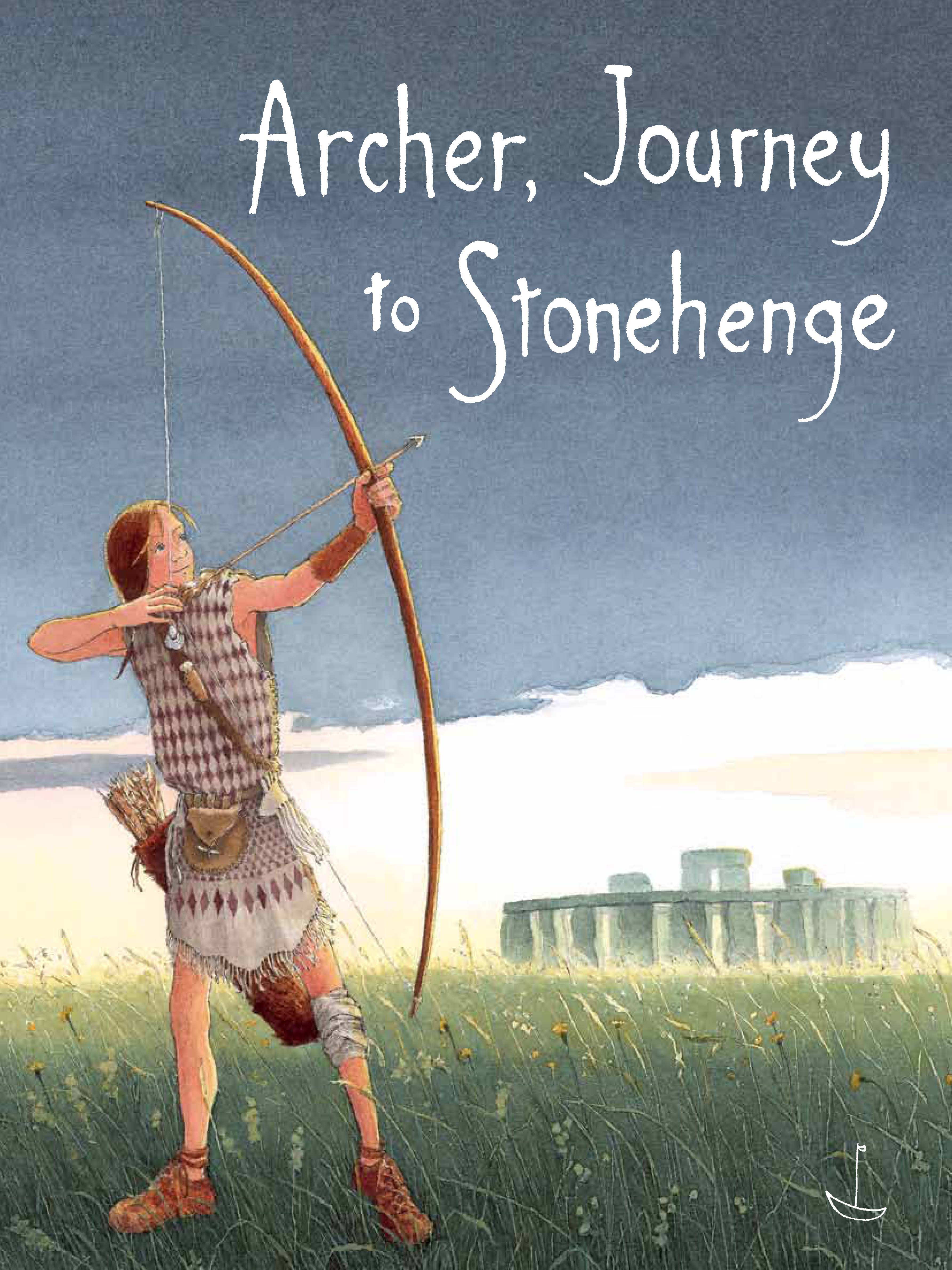
Archer, Journey to Stonehenge
An exciting comic-strip adventure story for children
written and illustrated by Jane Brayne
Links to the National Curriculum at KS 2
Buy it directly from us:


Books will be dispatched with all possible speed. Many thanks for your order.
To read more about how the book was written and illustrated janebrayne.wordpress.com
2300 BC, the Stone Age is ending.
The young stranger wears gold rings in his hair and copper daggers in his belt.
He carries his long bow and a quiver of flint-tipped arrows.
From a distant land he brings new magic to Stonehenge.


In 2002 a team from Wessex Archaeology, led by Professor Andrew Fitzpatrick, excavated the burial of a prehistoric man on a hillside at Amesbury, about two miles from Stonehenge. In his grave they found copper daggers, flint arrowheads, gold hair tress rings, beaker pots and much more – around 100 objects in all. One of the man’s ribs and his left kneecap were missing. Visit http://www.wessexarch.co.uk for more info.
A day or two later I had a ‘phone call from Andrew. Wessex had put out a press release about their amazing find – it was the richest Beaker Period burial ever found in Britain and one of the earliest. Their web site was getting more hits than ever before. The world’s press was writing articles; the Sun’s headline read ‘King of Stonehenge’- unlikely…


The archaeologists were calling him the Amesbury Archer. Later, when his radio-carbon dates came back from the lab, he was found to have lived around 2300 BC – about two hundred years after the sarcen stones were erected at Stonehenge. Analysis of strontium and oxygen isotopes in his teeth suggested that he had made a long journey to Stonehenge, probably from the Alpine region. Many of the objects in his grave appeared to be of continental European origin.
An image of the man in the grave was needed – how quickly could I paint one???
I live an hour’s drive from Stonehenge and went over to look at the dig and find out what I could. Speed was of the essence so one of the diggers, who was more or less the same height and build as the man in the grave, gallantly volunteered to pose for some photos for me to use as a starting point for an illustration. (Jackie McKinley, senior osteoarchaeologist at Wessex, had just about had time to give the bones a brief examination). Up on the King Barrow Ridge, with cars and trucks rumbling along the A303 and Stonehenge below him in the valley, he pretended to fix an arrowhead to its shaft.

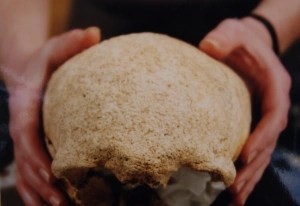
The Archer’s cranium
Jackie is holding the Archer’s left femur next to her own leg to show the curved shape of the bone. This was found to have been caused over a significant length of time, probably as a consequence of an injury to his left knee which resulted in the loss of his patella.
(The photographs of the finds shown here were taken by me on that first visit to Wessex Archaeology – apologies for their patchy quality…)

Within a week I had the painting ready. Looking at it with hindsight, now that an enormous amount of research has been done by a whole team of people, there are quite a few things I’d change. But that’s the way it goes in my line of work…

 Archer, Journey to Stonehenge